
There are no items in your cart
Add More
Add More
| Item Details | Price | ||
|---|---|---|---|
Stop limiting Commerce to just CA and MBA. ✋
Mon Dec 15, 2025
The selection of the Commerce stream by Indian students often results in an underestimation of its potential scope, frequently limiting career perceptions to Chartered Accountancy (CA), Master of Business Administration (MBA), and commercial banking roles. Analysis demonstrates that the Commerce stream provides a robust foundation for over 400 distinct career paths, establishing it as an exceptionally versatile academic discipline. This expansive landscape necessitates strategic, deliberate career planning, superseding strategies based merely on external pressures or popular trends.
Commerce education provides the essential structural knowledge underpinning the global economic system. The detailed career compendium delineates professional opportunities across 13 major sections, affirming that the potential for specialization is substantial. Key domains identified in this comprehensive analysis include:
In total, the resource identifies over 370 distinct career paths across these functional areas, confirming the expansive utility of a commerce foundation.
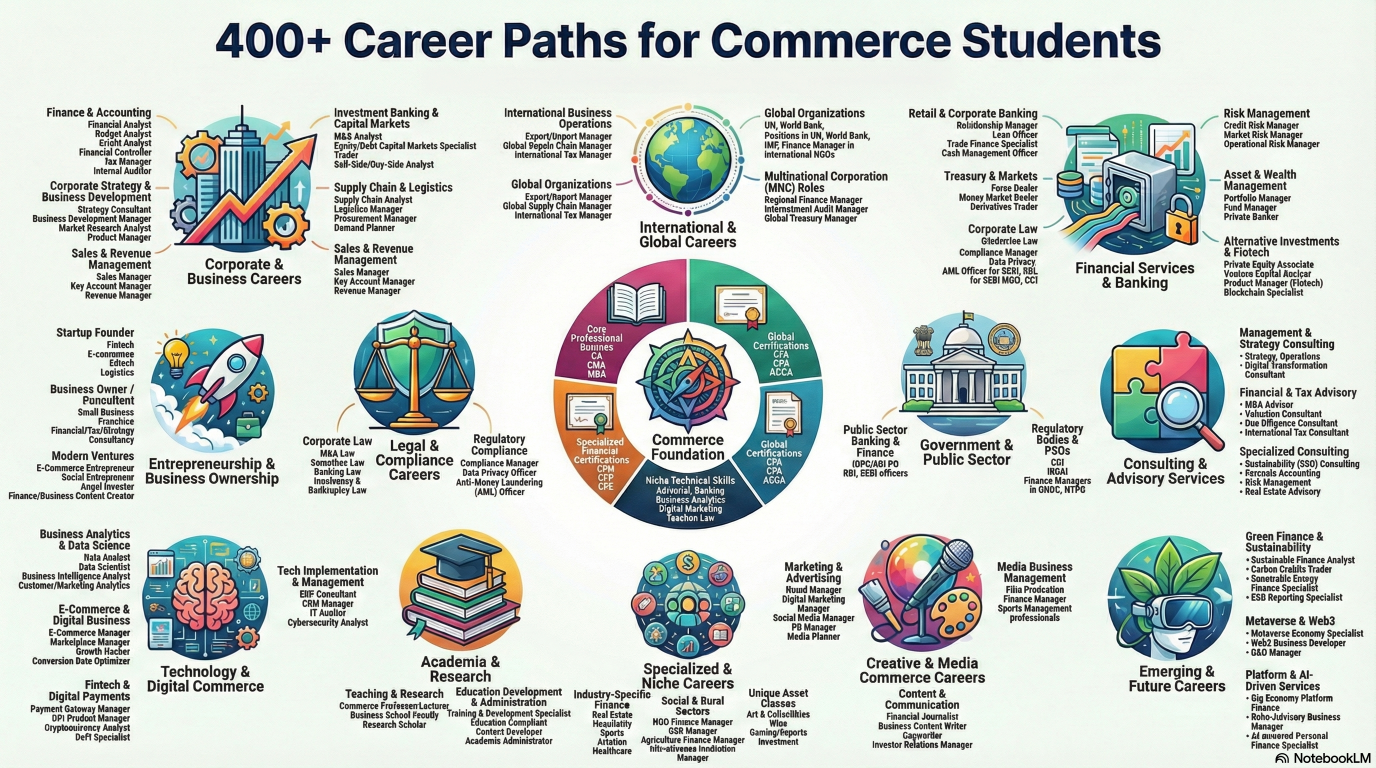
Formal professional qualifications constitute critical pathways to specialized, high-profile careers, providing internationally recognized expertise. Rigorous programs are designed to cultivate high standards of technical proficiency in areas vital to corporate and public sector operations:
For professionals with international aspirations, the Chartered Financial Analyst (CFA) designation, governed by the USA-based CFA Institute, is highly relevant for advanced financial roles such as Portfolio Manager, Risk Manager, and Investment Banker. Further global recognition can be achieved through credentials such as Certified Public Accountant (CPA - USA) and the UK's Association of Chartered Certified Accountants (ACCA - UK), essential for multinational corporate assignments.
The most rapidly expanding career opportunities necessitate the integration of core commerce competencies with specialized, adjacent skillsets. This hybridization is critical for modern commercial success:
A. Technology and Analytics: The contemporary commerce professional must be proficient in the analysis of quantitative data. The career list outlines paths in Business Analytics and Data Science, where commerce principles are combined with predictive modeling to create roles like Data Scientist and Business Intelligence Analyst. In the Fintech sphere, emerging roles include Digital Banking Manager and Payments Product Manager, demanding financial expertise integrated with digital platform management.
B. Law and Regulatory Compliance: The synergistic relationship between commerce and law is formalised through integrated programs such as the 5-Year B.Com LLB. This rigorous qualification prepares graduates for high-demand legal roles in the corporate sector, including Corporate Counsel, Securities Lawyer, and Insolvency & Bankruptcy Lawyer.
C. Creative and Media Commerce: For individuals demonstrating high communication and creative aptitudes, pathways exist in fields like Digital Marketing Manager, Content Marketing Manager, and Financial Journalist. These roles require commercial acumen to drive performance and marketing strategy (ROI analysis).
Given the extensive nature of the 400+ career trajectories, strategic planning predicated upon objective self-assessment is imperative for successful navigation. The selection process mandates the rigorous consideration of three critical dimensions, moving beyond subjective interest to formal compatibility:
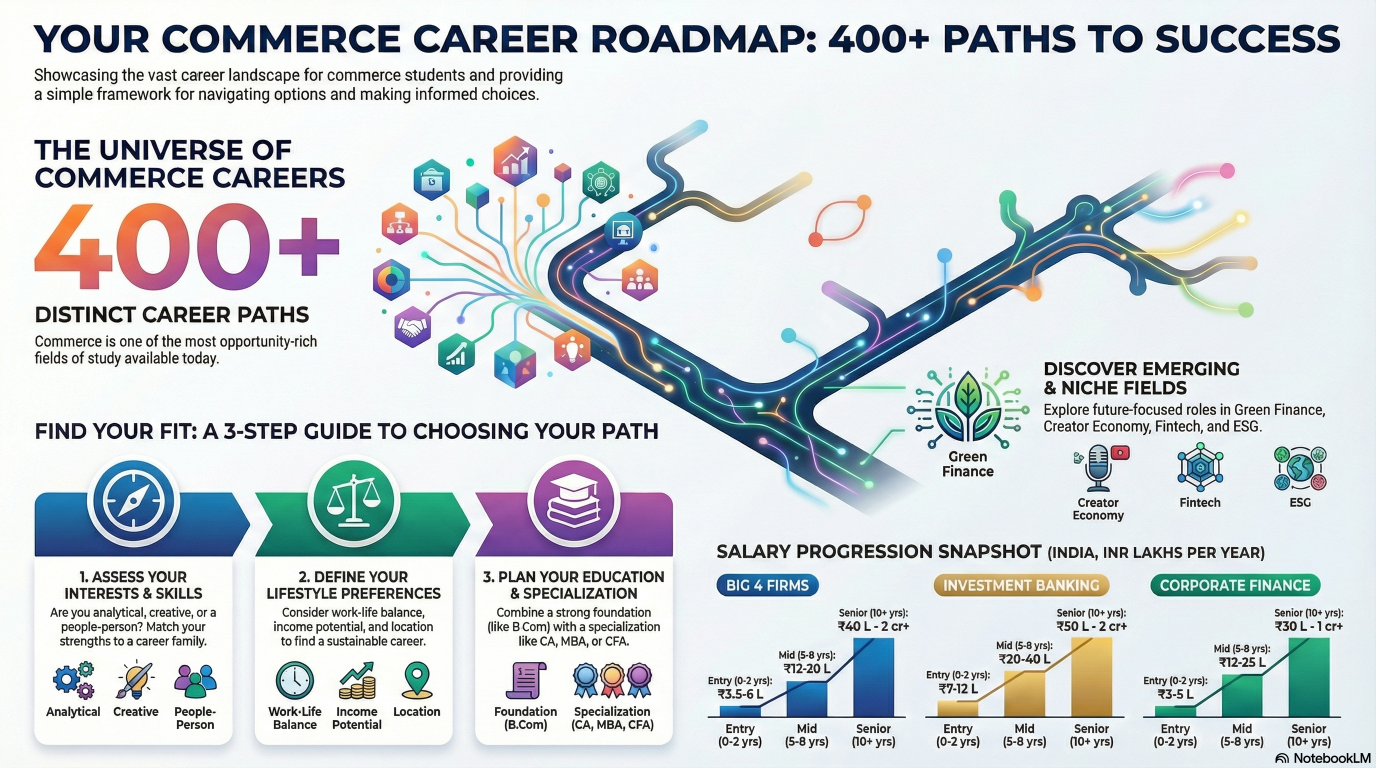
I. Self-Assessment and Aptitude Analysis
Career choice should align with inherent abilities and preferences. The primary interest clusters dictate optimal pathways:
II. Lifestyle and Value Congruence
The professional longevity of a career is often determined by its fit with personal values and lifestyle expectations. These factors vary significantly across sectors:
III. Educational Path Selection
The chosen undergraduate path structures subsequent specialization options:
In conclusion, the Commerce stream presents virtually unlimited career possibilities, contingent upon the student employing strategic planning, recognizing the importance of specialized credentials (CFA, FRM, etc.), and conducting rigorous self-reflection informed by both aptitude and lifestyle preferences. The successful professional pathway is defined by a continuous synthesis of a strong academic base, specialized skill sets, and adaptive soft skills.

Aim Highh Forum
An Odisha-based Entrepreneur, Economist, and Venture Strategist.